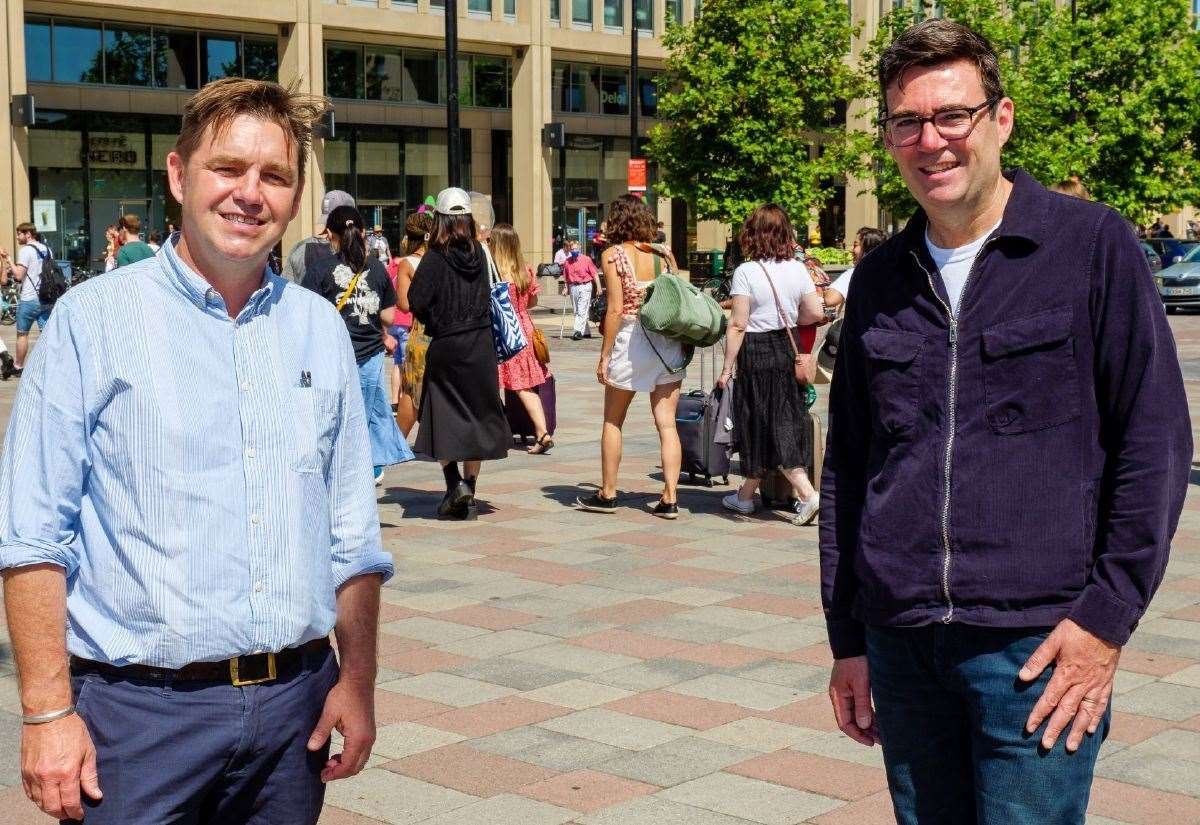
Our political correspondent, Phil Rodgers, writes to the prospective Prime Minister with his thoughts on the challenges facing the Cambridge area.Dear Andy Burnham,It’s still slightly too soon to say ‘Dear Prime Minister’, as a few days still remain until you move into Number Ten, or perhaps a few weeks if a last-minute challenger appears in the Labour leadership contest. One way or another, though, it’s pretty safe to assume that you’ll soon be Larry the cat’s new housemate. I realise you’ll have a lot on your mind, and plenty of people wanting to bend your ear. Here in Cambridge, we are certainly very interested in what your leadership is going to mean for the many challenges facing our city. So I hope you won’t mind a few thoughts.The then Greater Manchester mayor Andy Burnham visited Cambridge and met Dr Nik Johnson, the then Cambridgeshire and Peterborough mayorFirst of all, the prospect of a Prime Minister who went to university here is a welcome change. It’s certainly been long enough – the last Cambridge-educated PM was Stanley Baldwin, who left office in 1937 – and in the meantime no fewer than 14 of the last 17 Prime Ministers have been educated at another well-known university city. Many future MPs choose a degree subject like law, or history and politics, so some people might wonder if your choice of English literature was the best preparation for high political office. However, your former boss at the Department for Culture, Media and Sport, Lord Chris Smith, now chancellor of the University of Cambridge, would certainly disagree. He recently wrote in the Telegraph that there is “no better preparation for a career in public life than English literature, because it tells you more about character, relationships, society, joy, sorrow, emotion and intelligence than anything else ever could.”Lord Chris Smith, former master of Pembroke and now chancellor of the University of Cambridge. Picture: Keith HeppellAs mayor of Greater Manchester, you were instrumental in setting up the innovation partnership between Manchester and Cambridge, working first with your Labour colleague Nik Johnson, mayor of the Cambridgeshire and Peterborough Combined Authority, and then with his Conservative successor Paul Bristow. Last year this led to the establishment of the Cambridge x Manchester Partnership organisation, which describes itself as “designed to expand and strengthen innovation ecosystems in both cities, drive investment, and define a new model of collaboration for the UK”. Earlier this year the partnership published its baseline report, analysing innovation activity in both cities. It’ll be very interesting to see how its work develops, and perhaps acts as a pattern for other parts of the country under your government.Andy Burnham comfortably won the Manchester mayoral election in 2024. Graphic: Phil RodgersOpinion polling for the upcoming Manchester mayoral election puts Labour narrowly ahead of Reform UK. Graphic: Phil RodgersHopefully your successor as mayor of Greater Manchester will be keen to continue the partnership with Cambridge – though it’s perhaps a measure of the turbulence of modern politics that the by-election for your successor is a great deal less certain than your last mayoral election, as the graphs show. However, the government’s hurried restoration of the second-choice vote for mayoral elections is probably going to make things easier for Labour – and may well be a crucial factor in the next mayoral election for Cambridgeshire and Peterborough too.In March this year I heard you speak at Churchill College in Cambridge during the annual conference of the Bennett School of Public Policy, always a very interesting event. In a wide-ranging talk there were several themes that shone through: the long struggle to build an integrated public transport system in Manchester, your support for devolution and place-based policy against centralised Whitehall control, your frustration with what you see as the Treasury’s focus on controlling spending rather than promoting growth. One particularly interesting question you were asked was which political leaders you admire. As well as a perhaps obligatory mention of Keir Starmer, you cited former Democrat mayor of New York City Michael Bloomberg, Canadian prime minister Mark Carney, Australian prime minister Anthony Albanese, and said you were watching the new mayor of New York City, Zohran Mamdani, with great interest.Net satisfaction with public transport is far higher in Manchester than in Cambridgeshire. Graphic: Phil RodgersManchester’s approach to public transport has certainly proved popular with its residents. As the graph shows a survey by Ipsos UK in 2024 found that net satisfaction with public transport in Manchester stood at 46 per cent, compared with just 8 per cent in Cambridge, and even lower levels in South and East Cambridgeshire. Bus franchising may eventually improve things in the county, but despite years of discussions about mass rapid transit for Cambridge, any implementation still seems a very long way off, while development plans threaten to add even more traffic to our already congested roads.On devolution, Cambridge is in an unusual position. While powers and budgets have indeed been devolved from central government to the Combined Authority, the greater Cambridge area now finds itself facing a certain amount of reverse devolution. This is due to the proposed Greater Cambridge Development Corporation (GCDC), which is set to take planning powers away from local councils and wield them directly, without the involvement of elected representatives. If there is one thing that unites local councillors across parties at the moment, it is the feeling that this would be a bad idea. Perhaps it is a policy that a government truly committed to devolution might want to revisit. We’ll have to wait and see what changes the early days of your government will bring for the city. So far there aren’t many signs of radical policy changes in the early days. Local government reorganisation seems set to roll on, the Cambridge Growth Company continues its work, detailed planning for East West Rail is likely to continue. While we may not see substantial change for Cambridge in the short term, it’s the longer term projects that will really make a difference to the city.The work of the GCDC is likely to be the most important thing central government does in Cambridge over the coming decades, and it is crucial for the city that it does it well. We know the people involved have a great deal of talent and experience, and we also know what a good redevelopment looks like – we see one whenever we travel to London via King’s Cross. But unlike Cambridge, the old King’s Cross was not full of articulate and well-organised residents determined to oppose development plans. For the GCDC to succeed, it’s vital that they work with the city’s elected representatives, making the most of local knowledge and expertise, rather than simply imposing change from outside. As well as ensuring democratic accountability, this approach has the best chance of preserving the best aspects of the city. For all its challenges, Cambridge has many strengths, and in many ways is a great place to live. Please don’t let central government screw it up.Phil
Phil Rodgers: A letter to Andy Burnham to put him in the picture about Cambridge